




Movement Disorders
Latest News
Advertisement
Latest Videos



CME Content






Advertisement
More News
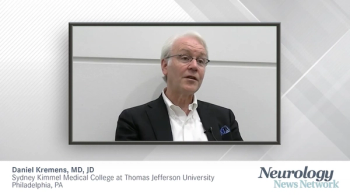
Kremens gave closing thoughts on the promise of the Parkinson disease research field, the outlook of drug development, and what clinicians should be excited for next.

Treatment with SAGE-324/BIIB124 for essential tremor resulted in adverse events that included somnolence, dizziness, fatigue, and balance disorder.
Daniel Kremens, MD, JD, described positive 18-month data on bemdaneprocel, an investigational cell-based approach for patients with Parkinson disease.

Findings from a recent study suggest that the presence of negative myoclonus may serve as a diagnostic clue for progressive myoclonus ataxia, suggesting the presence of genetic disorders.
The director for the Gene Therapy Institute at The Ohio State University talked about the latest developments in gene therapy for patients with Parkinson disease. [WATCH TIME: 4 minutes]

Here's some of what is coming soon to NeurologyLive® this week.
Test your neurology knowledge with NeurologyLive®'s weekly quiz series, featuring questions on a variety of clinical and historical neurology topics. This week's topic is on treatment-refractory epilepsy.

ASPIRO, an open-label trial, will assess the safety and tolerability of ANPD001, an investigational autologous neuronal replacement therapy being studied as a regenerative therapy for PD.

Neurology News Network. for the week ending May 4, 2024. [WATCH TIME: 3 minutes]

Take 5 minutes to catch up on NeurologyLive®'s highlights from the week ending May 3, 2024.

The associate chair for technology and innovation at the NYU Grossman School of Medicine provided commentary on a study from AAN 2024 that examined the driving factors behind burnout in neurology departments. [WATCH TIME: 4 minutes]

The chief scientific officer of the Parkinson’s Foundation and chief executive officer of Tasso discussed their company partnership to expand and accelerate genetic research in Parkinson Disease. [WATCH TIME: 6 minutes]

Leslie Citrome, MD, MPH, clinical professor of psychiatry and behavioral sciences at New York Medical College, shared his reaction to the recently approved new sprinkle formulation of valbenazine for patients with tardive dyskinesia.
In this segment, Kremens described pump therapies currently in development, such as ND0612 and ABBV-951.
Kremens gave thoughts on the use of several investigational continuous agents, including IPX203, risvodetinib, and P2B001.

The original approval for chorea associated with Huntington disease was based on the phase 3 KINECT-HD study, an 128-patient cohort trial in which valbenazine met its primary end point.

The FDA approval of Medtronic’s spinal cord stimulator makes it the first on the market to offer a closed-loop feature that senses biological signals along the spinal cord and automatically adjusts stimulation in real time for chronic pain.

The chief medical officer at Biohaven provided insight on its investigational spinocerebellar ataxia agent troriluzole, the advantages of the newly developed SCACOMS measure, and how the therapy stacks against natural history data. [WATCH TIME: 4 minutes]
Here's some of what is coming soon to NeurologyLive® this week.
Test your neurology knowledge with NeurologyLive®'s weekly quiz series, featuring questions on a variety of clinical and historical neurology topics. This week's topic is on primary progressive aphasia.

As part of our monthly clinician spotlight, NeurologyLive® highlighted movement disorder expert Kelly Papesh, DNP, APRN, FNP-BC, executive director of the Association of Movement Disorder Advanced Practice Providers.
Neurology News Network. for the week ending April 27, 2024. [WATCH TIME: 3 minutes]
Take 5 minutes to catch up on NeurologyLive®'s highlights from the week ending April 26, 2024.
In this conversation, Kremens discussed the common use of antiemetics in Parkinson disease, the real-world data surrounding these agents, and whether there are certain clinical advantages to apomorphine hydrochloride injection.

A recent study showed the relationship between genes associated with lysosomal function and environmental exposure to pesticides in Parkinson disease.
Advertisement
Advertisement
Trending on NeurologyLive - Clinical Neurology News and Neurology Expert Insights
1
Cladribine Tablets Show Ability to Improve or Stabilize Cognitive Function in Patients With Relapsing Multiple Sclerosis
2
Cladribine Maintains Efficacy, Safety Profile in Older Patients With Multiple Sclerosis
3
Myelin Protective Small Molecule Lucid-MS Shows Promising Early-Stage Data in Healthy Volunteers
4
CD40L Inhibitor Frexalimab Enters Phase 3 FREXITE Trial of Non-Relapsing Secondary Progressive Multiple Sclerosis
5