



Movement Disorders
Latest News
Advertisement
Latest Videos


CME Content






Advertisement
More News

Q-Motor, an objective measure of motor function, showed robust beneficial effects for individuals treated with pridopidine in PROOF-HD at various time points.

The medical director of the Center for Neurological Disorders at the University of Toledo discussed positive phase 3 findings assessing P2B001, and how the agent would potentially fit in the Parkinson treatment landscape. [WATCH TIME: 4 minutes]

The chief medical officer and cofounder of CND Life Sciences, who served as principal investigator of the study, offered insight into the Syn-ONe Test's clinical utility.

The pump, attached to a wearable retainer, continuously delivers the liquid medication with little to no adverse effects.
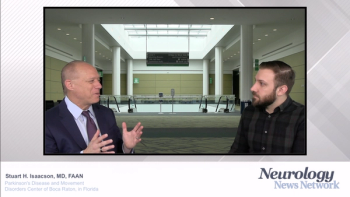
Stuart H. Isaacson, MD, FAAN, offers insight into the importance of tailoring care to the individual when it comes to managing patients with Parkinson disease.

CND Life Sciences’ α-synuclein skin biopsy test showed sensitivity rates ranging from 92.7% to 100% across a number of assessed and clinically confirmed synucleinopathies, including Parkinson disease and dementia with Lewy bodies, among others.

The expert neurology panel discusses clinical trial data of amantadine-DR/ER in treatment of dyskinesia and OFF episodes in Parkinson disease.

Drs William G. Ondo and Rajesh Pahwa analyze the pharmacokinetics of different formulations of amantadine for treatment of dyskinesia in Parkinson disease.

No significant differences between P2B001 and Prami-ER were seen in total UPDRS responders, UPDRS Part II, and UPDRS Part III scores among those with Parkinson disease.
Adverse events like dyskinesia, ON and OFF phenomenon, and falls, were all higher during the 4-week optimization phase than the 8-week maintenance phase.

Compared with immediate-release levodopa/carbidopa, NeuroDerm’s 24-hour subcutaneous liquid infusion improved ON time without dyskinesia and with nontroublesome dyskinesia.

Here's some of what is coming soon to NeurologyLive® this week.
Test your neurology knowledge with NeurologyLive®'s weekly quiz series, featuring questions on a variety of clinical and historical neurology topics. This week's topic is the history of the American Academy of Neurology.
The majority of treatment-emergent adverse events from IPX203 were mild or moderate in nature, and occurred within the first 90 days of treatment.
Take 5 minutes to catch up on NeurologyLive®'s highlights from the week ending April 21, 2023.

Andrew Siderowf, MD, director of the Parkinson disease and movement center at the University of Pennsylvania, talked about available therapeutics and potential future therapies in research for Parkinson disease.

Despite years of use of gold-standard therapy levodopa, therapeutic development in Parkinson disease has advanced rapidly and expanded to numerous novel pathways and targets.
The director of the Memory & Cognitive Disorders Clinic at Hoag Neuroscience Institute provided detail on an educational course that examined medication management for Parkinson disease psychosis.

Drs Rajesh Pahwa, Daniels Kremens and Fernando Pagan provide an overview of current treatment options for treatment of dyskinesia in patients with Parkinson’s Disease.
The expert panel highlights challenges in treatment of OFF episodes and dyskinesia together and long-term consequences of delaying treatment for dyskinesia in patients with Parkinson disease.

As therapeutic development has advanced in Parkinson disease management, the introduction of on-demand options have extended ON time for patients and altered the paradigm of care.

Psychosis is estimated to affect more than half of patients with Parkinson disease, and there is a growing need for improved management and therapeutic development.
Here's some of what is coming soon to NeurologyLive® this week.
Test your neurology knowledge with NeurologyLive®'s weekly quiz series, featuring questions on a variety of clinical and historical neurology topics. This week's topic is stroke and cerebrovascular disease.

The holy grail of neurodegenerative disorders would be to alter or halt the progression of the disease. For years, the discussion has swirled around stem cells and gene therapy, and they remain potential options for the future.
Advertisement
Advertisement
Trending on NeurologyLive - Clinical Neurology News and Neurology Expert Insights
1
Cladribine Tablets Show Ability to Improve or Stabilize Cognitive Function in Patients With Relapsing Multiple Sclerosis
2
Cladribine Maintains Efficacy, Safety Profile in Older Patients With Multiple Sclerosis
3
Myelin Protective Small Molecule Lucid-MS Shows Promising Early-Stage Data in Healthy Volunteers
4
CD40L Inhibitor Frexalimab Enters Phase 3 FREXITE Trial of Non-Relapsing Secondary Progressive Multiple Sclerosis
5