



MS and Demyelinating Disorders
Latest News
Advertisement
Latest Videos



CME Content






Advertisement
More News

Jemima Akinsanya, DO, Neuroimmunology Clinical Fellow at the National Institutes of Health, discussed new studies of anakinra and tolebrutinib in MS.

The senior director of patient management, care, and rehabilitation research at the National MS Society discussed symptoms of progressive MS that need more attention and research.
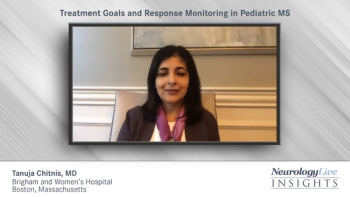
Tanuja Chitnis, MD reviews the 2018 AAN guidelines on disease-modifying therapies and discusses goals of therapy when selecting first-line treatments and monitoring response in pediatric multiple sclerosis.

Experts in multiple sclerosis discuss the importance of a multidisciplinary approach for pediatric patients and emphasize the role of social workers, psychologists, and support groups for patients and families.

The postdoctoral researcher at Columbia University discussed the use of the DISCO-MS survey and its potential for future research projects.

Ilena George, MD, of Massachusetts General Hospital, discussed a cohort of patients with early DMT prescription and low rates of clinical conversion.
Richard describes the journey of his diagnosis with multiple sclerosis.

Here's what is coming soon to NeurologyLive.

Treatment with fingolimod followed by alemtuzumab led to an increase in spinal relapses as well as increased risk of secondary autoimmunity.
Take 5 minutes to catch up on NeurologyLive's highlights from the week ending April 9, 2021.

Understanding Mechanisms of MS Chronic Inflammation: Jemima Akinsanya, DO, and Daniel Reich, MD, PhD
The duo from the National Institutes of Health discussed how monitoring and treating paramagnetic rim lesions can improve patient care in multiple sclerosis.

Yujie Wang, MD, a neurologist from the University of Washington Medical Center, discussed examining the 1-hour post monitoring period of natalizumab infusion amid the COVID-19 pandemic.

Annualized relapse rate reduction, fatigue, magnetic resonance imaging activity, brain volume loss, and no evidence of disease activity status were all superior in the ponesimod-treated group.
Experts in the field of multiple sclerosis discuss patient selection for drugs based on disease activity.
Kristen Krysko, MD, summarizes the results of the phase III ORATORIO trial and discusses the rationale for using ocrelizumab for the treatment of progressive multiple sclerosis.
The senior director of patient management, care, and rehabilitation research at the National MS Society discussed the lack of studies on progressive MS compared to RRMS.

Researchers found significant differences between clinically relevant areas in participants with progressive MS, relapsing MS, and healthy controls.

Stephanie Blandford, MSc, a PhD candidate at Memorial University of Newfoundland, discussed some advantages of using IL-1RA over NfL in predicting disability in multiple sclerosis.
The PhD candidate at the Barts MS Center in London discussed the upcoming Chariot MS study as well as further research she would like to conduct in personalized cladribine dosing.

Expert neurologist Lauren B. Krupp, MD provides insight into the use of diagnostic tools for pediatric multiple sclerosis such as MRI imaging, laboratory blood tests, and lumbar punctures.
Key opinion leaders in the management of MS comment on the current diagnostic criteria and discuss the importance of ruling out other common mimics in pediatric patients.

Alise Carlson, MD, a resident at Cleveland Clinic, provided insight on how raising awareness for genetic leukodystrophies may ultimately improve misdiagnosis rates.

A patient, Richard, discusses his positive experience with multiple sclerosis virtual visits during COVID-19.
Mary Ann Picone, MD, describes the incorporation of televisits for multiple sclerosis during COVID-19.
Here's what is coming soon to NeurologyLive.
Advertisement
Advertisement
Trending on NeurologyLive - Clinical Neurology News and Neurology Expert Insights
1
Cladribine Tablets Show Ability to Improve or Stabilize Cognitive Function in Patients With Relapsing Multiple Sclerosis
2
Myelin Protective Small Molecule Lucid-MS Shows Promising Early-Stage Data in Healthy Volunteers
3
Cladribine Maintains Efficacy, Safety Profile in Older Patients With Multiple Sclerosis
4
Using Human iPSC Models to Dissect PIRA Mechanisms in Progressive Multiple Sclerosis: Valentina Fossati, PhD
5